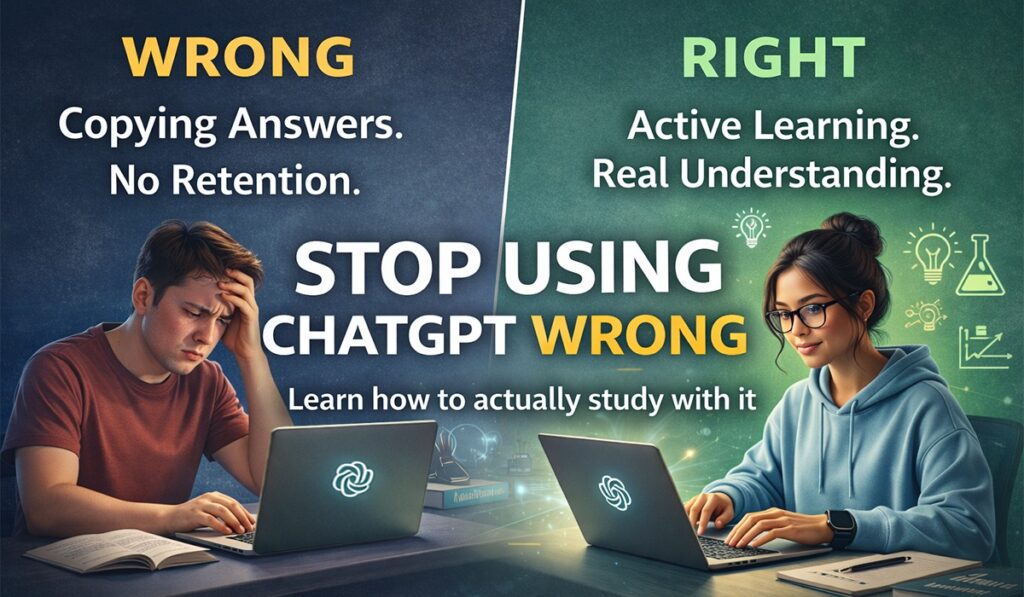
Let me be blunt with you. Most students are using ChatGPT completely wrong, and it is costing them grades, time, and genuine understanding.
They open it up, paste an essay question, hit enter, and copy whatever comes out. That is not studying. That is intellectual outsourcing. And the worst part? It doesn’t work. You walk into an exam with zero retention, zero confidence, and zero ability to think on your feet.
But here is the thing: when you use ChatGPT correctly, it becomes one of the most powerful study tools ever created. We are talking about a personalised tutor available 24/7, at zero cost, that can explain quantum physics in plain English, quiz you on the French Revolution, or break down a Shakespeare sonnet line by line.
The difference between a student who fails and a student who thrives isn’t access to ChatGPT. It’s how they use it.
Let me show you exactly how to do it right.
Multiple Steps and Ways to Use ChatGPT for Your Learning
1. Stop Asking for Answers. Start Asking for Explanations.
Here is where most students go wrong immediately.
They type: “What caused World War One?”
ChatGPT spits out five paragraphs. They read it. They forget it within 48 hours. Nothing sticks because they did not process it; they just consumed it passively.
Instead, try this: “Explain the main causes of World War One to me as if I’m 15 and have never studied it before. Then ask me a question to check if I understood.”
See the difference? You are not asking for a shortcut. You are asking for comprehension. And by prompting ChatGPT to follow up with a question, you have created a genuine back-and-forth learning loop.
This is called active recall, and it is the single most evidence-backed study technique in cognitive psychology. When you retrieve information from memory, rather than simply re-reading it, retention skyrockets.
Make this your default mode with ChatGPT. Always end your prompts with: “Now quiz me on what I just learned.”
2. Use It as a Personalised Explainer for Concepts You’re Stuck On
Every student has that one topic that just does not click.
For some, it is cellular respiration. For others, it is trigonometry. For others still, it is understanding metaphor in literature. Whatever your sticking point is, ChatGPT can explain it from multiple angles until something finally lands.
Here is a prompt that works brilliantly: “I do not understand [concept]. Can you explain it three different ways: one using an analogy, one with a real-world example, and one in the simplest possible terms?”
That triple-explanation approach is incredibly powerful. It is the equivalent of having three different teachers explain the same thing in three different ways. Research shows that multiple representations of a concept dramatically improve understanding and long-term retention.
Science students: this is gold for subjects like biology, chemistry, and physics, where abstract processes can be hard to visualise.
Humanities students: you can use it to unpack complex texts, analyse themes, or understand historical context. You can ask ChatGPT: “What was the social and political atmosphere in 1984 that Orwell was responding to?” Then follow up. Keep the conversation going. You need to treat it like office hours with a professor.
3. Build Your Own Custom Quiz Bank
Here is a study hack most students never think of. At the end of each topic you study, go to ChatGPT and say: “Generate 10 exam-style questions on [topic] — mix multiple choice, short answer, and one extended response. Then give me the answers separately so I can test myself.”
What you have just done is create a personalised practice exam in under 30 seconds. You need to do this for every unit, every chapter, every topic. By the time your actual exam arrives, you will have hundreds of practice questions already waiting for you. These are questions tailored to exactly what you have been learning.
You can take it further. Say: “Make the questions harder. Assume I already understand the basics.”
Or: “Generate questions in the style of the HSC exam for this topic.”
ChatGPT can adapt to your level, your syllabus, and your goals. Most commercially produced study guides can’t do that.
4. Use It to Improve Your Writing — Not Write For You
Let’s address the elephant in the room.
You should not be asking ChatGPT to write your essays. Not because it is cheating (though it often is), but because it robs you of the one skill that will matter most in every job, university course, and professional situation you ever encounter. And it is the ability to construct a clear, compelling argument.
But here is what you should be doing.
Write your essay yourself. Then paste it into ChatGPT with this prompt: “Do not rewrite this. Instead, give me specific feedback on my argument structure, use of evidence, and clarity. Point out where my reasoning is weak.”
Suddenly, you have an editor. A rigorous, patient, detail-oriented editor who does not get tired, does not charge by the hour, and will not soften the feedback to spare your feelings.
Then take that feedback and revise the essay yourself. This is how real improvement happens — not by outsourcing your thinking, but by pressure-testing it.
You can also use ChatGPT to practise essay planning. Give it a question, ask it to help you brainstorm a thesis and three supporting arguments, and then go away and write the whole thing independently. Use it for structure, not substance.
5. Create Study Summaries and Mind Maps
Before an exam, the goal is to compress information to take everything you have learned across weeks of classes and reduce it to its clearest, most essential form.
ChatGPT does this brilliantly.
Try: “Summarise everything I need to know about [topic] for my HSC exam in a structured, dot-point format. Group it by subtopic.”
You will get a tight, organised revision sheet in seconds. But do not just read it; you need to use it as a skeleton and fill in the details from your own notes and memory. You can compare what ChatGPT produces to what you remember. The gaps you find are exactly what you need to study next.
For visual learners, you can ask it to outline a mind map: “Give me a mind map structure for [topic] — list the central idea, main branches, and sub-branches.” Then recreate it by hand. The act of drawing it yourself, rather than printing it, significantly improves memory encoding.
6. Simulate Exam Conditions
This is the most underused feature of ChatGPT for students, and arguably the most powerful.
Tell it: “You are an exam invigilator. Give me one HSC-style extended response question on [topic]. I will write my answer in 20 minutes. When I paste it back, mark it out of 10 with a detailed breakdown and tell me specifically how to improve it.”
You have just created a mock exam experience with instant, expert-level feedback.
Do this once a week in the lead-up to your exams. Each time, you are not just practising; you are getting targeted coaching on exactly where your answers fall short. No study guide, no YouTube video, and no flashcard app offers that level of personalisation.
7. Use ChatGPT to Master Science and Maths — Subject by Subject
This is where ChatGPT genuinely separates itself from every other study tool on the market.
Science and maths are not just about memorising facts. They are about understanding systems, how things connect, why formulas work, and what happens when variables change. ChatGPT excels at all of this. Here’s exactly how to use it, topic by topic.
Biology-
Biology is full of processes that are easy to memorise and hard to actually understand. Photosynthesis, mitosis, the immune response, and the nitrogen cycle. Students can recite the steps but cannot explain why each step happens.
Fix that with this prompt: “Walk me through the process of cellular respiration as if you are narrating a documentary. Explain what is happening at each stage and why it matters.”
Suddenly, it is not a list of steps. It is a story. And stories stick. You can also use ChatGPT to connect topics across the syllabus. Try: “How does the structure of a cell membrane relate to osmosis and active transport? Explain the connection.”
That kind of systems-thinking is exactly what HSC markers reward, and it is exactly what rote memorisation cannot give you.
Other high-value Biology prompts:
- “Explain the difference between mitosis and meiosis using a real-world analogy.”
- “Quiz me on the stages of the cell cycle. Tell me if my answers are right and why.”
- “What are the most commonly misunderstood concepts in genetics? Explain each one clearly.”
Chemistry-
Chemistry breaks students in two places: conceptual understanding (what is actually happening at the molecular level?) and mathematical application (how do I use this formula correctly?). ChatGPT handles both.
For concepts, try: “Explain what happens during a redox reaction at the atomic level. Use a simple example.”
For maths application, try: “Walk me through how to calculate the pH of a weak acid solution step by step. Explain every line.”
Here is a pro tip for chemistry specifically: you can ask ChatGPT to explain the logic behind a formula before you try to apply it.
Instead of: “What is the formula for Gibbs free energy?”
You need to ask: “Why does the Gibbs free energy equation look the way it does? What does each component actually represent in the real world?”
That shift, from “what” to “why”, is the difference between a student who can answer a familiar question and a student who can answer any question.
Other high-value Chemistry prompts:
- “I keep confusing molarity and molality. Explain both from scratch and give me a practice problem for each.”
- “What are the most common mistakes students make in equilibrium calculations? Show me how to avoid them.”
- “Generate five titration problems at increasing difficulty levels.”
Physics-
Physics is where maths and reality collide, and for a lot of students, it’s where confidence goes to die. The key to using ChatGPT for physics is forcing it to connect the equation to the physical situation. Do not just ask for formulas. Ask for meaning.
Try: “I’m studying projectile motion. Before showing me any equations, explain intuitively what happens to the horizontal and vertical components of velocity during flight and why.”
Once you have the intuition, the equations make sense. Without it, you are just pattern-matching symbols on a page.
For problem-solving, ChatGPT is a patient, infinitely available worked-example machine. Use it like this: “Solve this physics problem step by step. After each step, explain why you did that, not just what you did.”
That “explain why” instruction is critical. Most textbook solutions show the steps. ChatGPT can show you the thinking behind the steps which is what you actually need to replicate in an exam.
Other high-value Physics prompts:
- “Explain Newton’s Third Law with three different everyday examples.”
- “I’m stuck on circular motion. What are the key concepts I need to understand before tackling problems?”
- “Generate a set of practice problems on energy conservation — start easy and get progressively harder.
Mathematics-
Here’s the honest truth about using ChatGPT for maths: it is phenomenal for understanding and checking, but you must do the work yourself first.
The golden rule: you should never ask ChatGPT to solve a problem for you until you have attempted it yourself.
Once you have an attempt, use this prompt: “Here is my work for this problem. Do not just tell me the answer; identify exactly where I went wrong and explain the correct reasoning at that point.”
That targeted error analysis is worth ten correct solutions you watched someone else do. For building conceptual foundations, ChatGPT is brilliant at explaining why mathematical rules exist rather than just stating them.
Try: “Why does the quadratic formula work? Can you derive it from scratch and explain each step in plain English?”
Or: “I know how to differentiate using the chain rule, but I do not understand why it works. Explain it intuitively.”
Understanding the ‘why’ behind mathematical rules dramatically improves your ability to adapt them to unfamiliar problem types, which is exactly what harder exam questions demand.
Other high-value Maths prompts:
- “Create a set of 10 integration problems covering different techniques: substitution, by parts, and partial fractions.”
- “I always make mistakes with negative indices. Explain the rules clearly and give me five practice problems to check my understanding.”
- “What are the most common errors students make in HSC maths exams? How do I avoid them?”
Conclusion
ChatGPT is a powerful tool, but it works best alongside real expert guidance, especially for high-stakes subjects like the HSC. However, this tool cannot be the answer for all your problems. It can help facilitate the journey, but not the journey itself. For that, you can enlist the help of a private teacher. That is where tutoring comes in.
At Kalibre Education, we provide specialist HSC tutoring in Mathematics, English, Science and Humanities, right here in Punchbowl. Our experienced tutors do not just teach content; they teach students how to think, how to structure arguments, and how to walk into an exam with genuine confidence. Whether you are struggling with Biology, Chemistry, History, or English, Kalibre Education gives you the structured, personalised support that no AI can fully replace.