Let me be honest with you. Economics is one of the most misunderstood subjects in the HSC. Students walk into Year 11 thinking it is about money and markets. Then they hit macroeconomics, global trade, and government policy. And suddenly, it all feels overwhelming.
Sound familiar? Here is the good news: with the right economic tutoring in Sydney, your child does not just survive Economics. They thrive in it.
And in this post, I am going to show you exactly why a structured, expert-led tutoring program makes all the difference. It is especially true in the critical Year 11 and Year 12 years.
Why Economics Is Harder Than Most Students Expect
Economics is not just theory. It is not just memorising definitions. The NSW Stage 6 syllabus demands that students:
- Understand how real markets work.
- Analyse government policies critically
- Interpret charts, graphs, and economic data.
- Connect Australian economic events to global trends.
- Write structured, evidence-based responses under exam pressure.
That is a lot to handle, especially when you are also juggling Maths, English, and every other subject competing for your time. Most students do not struggle because they are not smart. They struggle because no one has shown them how to think like an economist.
That is where professional economic tutoring comes in.
What Good Economic Tutoring Actually Looks Like
Not all tutoring is created equal. Sitting in a room while someone reads from a textbook? That is not tutoring. That is just expensive homework time.
Real economic tutoring in Sydney does something different. It builds the way a student thinks, connecting theory to the real world, developing analytical skills, and giving students the confidence to tackle any question the HSC throws at them.
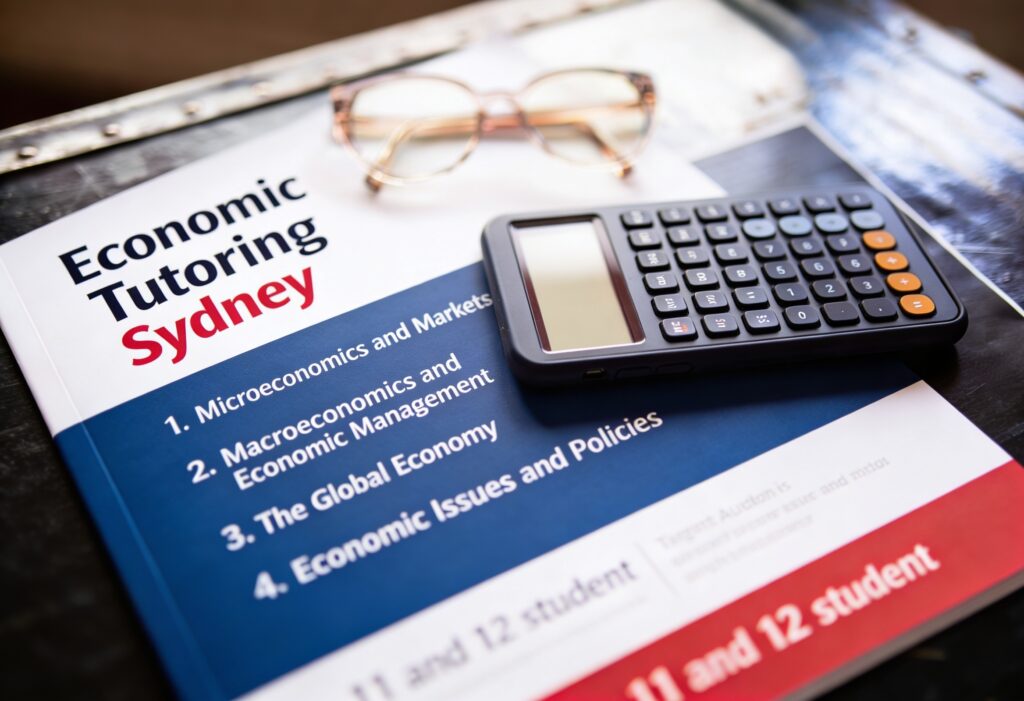
Here is what a quality Year 11 and Year 12 Economics tutoring program should cover:
1. Microeconomics and Markets
This is where it all starts. Students learn how consumers make decisions. How businesses respond to price signals. How governments intervene in markets, and why sometimes those interventions backfire.
Good tutoring does not just explain supply and demand diagrams. It asks: Why did petrol prices spike last month? How does that affect household spending in Western Sydney?
When students can answer those questions, the theory no longer feels abstract. It starts feeling real.
2. Macroeconomics and Economic Management
This is where many students hit a wall. Monetary policy. Fiscal policy. Interest rates. The Reserve Bank. Budget deficits. Unemployment cycles. It sounds complicated, and it can be, without the right guidance.
A strong tutoring program breaks these concepts down into digestible pieces. Students learn not just what these policies are, but why governments use them and how to critically evaluate their effectiveness. That critical evaluation is exactly what HSC markers are looking for in extended response questions.
3. The Global Economy
Australia does not exist in isolation. Students need to understand how global trade shapes the Australian economy. How exchange rates affect exporters. How China’s economic slowdown ripples into Australian iron ore prices.
The best economic tutoring connects these dots. It uses current events, not dusty textbook examples from 20 years ago, to make global economics tangible and relevant.
4. Economic Issues and Policies
This is the section that often determines Band 5 vs Band 6 results. Inflation. Unemployment. Economic growth. External stability. These are live, evolving issues, and HSC markers expect students to engage with them as such.
Students need to know the theory and the current Australian context. Tutoring that bridges that gap gives students a massive edge in extended response and essay questions.
The Key Skills That Separate Good Students from Great Ones
Here is something most parents do not realise. In HSC Economics, content knowledge is necessary, but it is not enough on its own. The students who score highest are the ones who have mastered four critical skills:
- Critical Thinking: Can they look at an economic issue from multiple angles? Can they identify strengths and weaknesses in a government policy?
- Real-World Application: Can they connect what they’ve learned in the classroom to what’s actually happening in the Australian and global economy?
- Data Interpretation: Can they read an economic graph or table and draw meaningful, accurate conclusions from it?
- Problem-Solving: When presented with a complex economic scenario, can they apply the right model and propose a logical solution?
These skills are not developed overnight. They are built through consistent practice, guided feedback, and a tutoring approach that challenges students to think, not just memorise.
Why Tutor Qualifications Actually Matter
Here is something worth paying attention to. There is a big difference between a university student who scored well in Economics and a tutor with actual tertiary qualifications in business and real-world industry experience.
When a tutor has studied Business and Banking at the University of Sydney and has practical experience in the business world, they don’t just teach from a textbook. They teach from understanding. They know how economic principles play out in real markets, real businesses, and real financial decisions.
That real-world credibility makes concepts stick. It gives students examples and insights they will not find in any textbook. And it helps them write the kind of sophisticated, nuanced responses that HSC markers genuinely reward.
What Personalised Tutoring Delivers That a Classroom Can’t?
Think about a typical Year 11 or Year 12 Economics class. One teacher. Twenty-five to thirty students. A fixed pace. A fixed curriculum timeline.
Some students grasp a concept immediately and are ready to move on. Others need it explained a different way. A few are still confused about something from three weeks ago, but they are too embarrassed to ask. Personalised economic tutoring Punchbowl solves this problem completely.
Lessons are built around the individual student, such as their strengths, their gaps, their learning style. If a student struggles with external stability, that’s where the lesson focuses. If they have already nailed microeconomics, the tutor pushes them further and faster.
Regular assessments and feedback mean there are no surprises. Parents and students always know where they stand and what needs to happen next.
The HSC Pressure Is Real, So Start Early
Here is the mistake I see families make all the time. They wait until Term 3 of Year 12, when trial exams are looming, and stress is through the roof, before seeking tutoring help.
By then, there are gaps in understanding that should have been filled twelve months earlier. The pressure is enormous. And the time to properly address those gaps is simply gone.
The students who perform best in HSC Economics are the ones who start building their skills early, in Year 11, before bad habits form and before content gaps become a crisis.
Starting in Year 11 gives students time to:
- Develop their analytical and writing skills gradually.
- Build confidence with complex economic concepts.
- Establish strong study habits before the pressure peaks.
- Enter Year 12 already ahead of their peers.
That head start is genuinely priceless.
Final Action
Economics does not have to be the subject that holds your child back. With the right economic tutoring, your child can walk into their HSC exams genuinely prepared and confident. When we say right tutoring, we mean expert tutors, a structured program aligned to the NSW Stage 6 syllabus, personalised lessons, and a real focus on critical thinking and application.
At Kalibre Education, we offer quality Economics tutoring designed specifically for Year 11 and Year 12 students. Our tutors bring tertiary qualifications in Business (Banking) from the University of Sydney, combined with real-world business experience, to deliver lessons that are engaging, relevant, and results-focused.
We proudly serve students across Punchbowl, Greenacre, Bankstown, and South West Sydney. Do not leave your child’s HSC results to chance. Reach out to Kalibre Education today and take the first step toward the Economics results your child deserves.